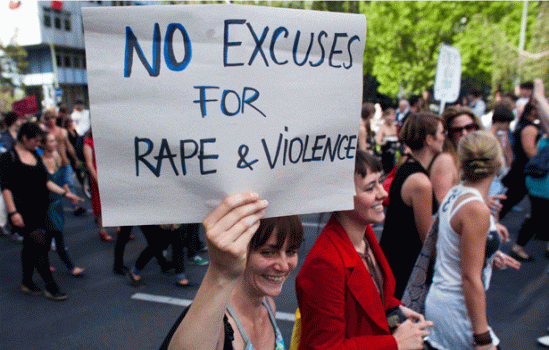
Where do I start? Writing a narrative is a bit challenging. I do not know where and when I should start my narrative. I mean, I have erased my sentences a few times, and just when I thought it was a good start, I erased it all over again. Was I too blunt and in your face? Am I taking too long to get to the point? Gosh, how about I start in the middle? My narrative here, what I want to talk about is my traumatic experience of being a victim of a sexual assault and my seasonal depression.
I didn’t noticed my seasonal depression until recently when someone close to me had mentioned that I maybe experiencing this every year at this time. I did not want to believe it but my trauma was more than enough for me to believe it. It is hard for me to talk about this traumatic experience. Even now as I write, I am reminded of the time, feelings, thoughts and struggle that I went through. I first came out about being sexually assaulted to a couple of my closest friends from high school. When I told them of my experience I thought that I would be more emotional and vulnerable, but I felt nothing of that sort. I felt numb. I gathered my emotions and got the courage to talk to them about my trauma, but that was it. I thought that it was enough that only two people knew. I did not want anyone else to know, especially not my family.

Source: http://reappropriate.co/2014/04/sexual-assault-domestic-violence-in-the-asian-american-community/
When I came back home from the trip I went with my co-workers and employee I was scared that my family would find out about the bruises–or in this case, hickeys on my neck. And they are not just your regular hickeys; they were huge and covered the whole front side of my neck. I panicked about what to do if my parents see this, if they saw the bruised-like hickeys on my neck. I had to cover it up with something and the answer was make-up; more precisely I used foundation to cover up my neck and it helped calmed me down. For a whole week I applied on the foundation until the bruised-like hickeys could no longer be seen. After my traumatic event, I tried to forget, but it never really went away and I was just lying to myself that it was not a big of a deal. I went through a whole year of keeping my traumatic event to myself without telling my parents. I pretty much do not remember what I did or how I did it so that I can keep my mind off of what happened to me.

I struggled with being a Hmong daughter and at the same time a victim of sexual assault. As a child, I was always warned to be careful around boys–and this was through the stories of girls being kidnapped, sexually assaulted, and/or raped. I thought “this will never happen to me,” because I know that I have been warned, thus I am careful around those who I interact with. I always think about what my mother has told me when going to someone’s house who I did not know, especially being careful of the drinks, because you never know what they could have put in it. In the stories my mother told me, these Hmong women were always portrayed as helpless beings or persons wanting to look for the attention by the way they dress and act. They were always with men who they did not know and were blamed for consequences as if they were seeking for it. This in turn has made me believe in a stereotype about how sexual assault and rape happens. In the most common myth, you are at a place far away from home, with some friends. You are probably having fun and staying out late at night. These guys who you do not know came up to you and offered you some drinks. (Be mindful that these drinks were already pre-ordered and not ordered in front of your face.) You drink it without knowing if it was drugged or not, and then, BAM! Next thing you know, you wake up in bed with a total stranger not knowing what happened. Although it was just a story, this myth was repetitively reinforced to me again and again, so I started to see; it became my reality. I have mentally prepared myself that if I shall ever come across this scenario, I’ll know exactly what to do.
In the communities we participate in and at home, we have gotten so worked up telling and preparing young girls about this horrid situation, which we seem to have dismissed the fact that it is not more than just a myth. In reality, it is NOT SOMEONE whom you DO NOT KNOW that will inflict this gender-based violence to you, but it is someone whom you personally know and have built a trusting relationship with, who can willingly commit gender-based violence to you. As a society, we always tell young girls not to take drinks from strangers or go out alone, but at the same time, we neglect to tell young boys not to rape. Socially and culturally, men and boys are not taught to respect women and girls’ bodies nor how to negotiate consent and not take advantage of women and girls as objects. This needs to change for the better.
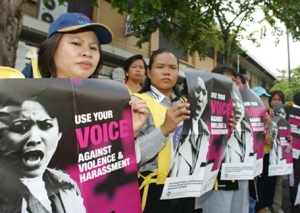
After a year of suffering from this trauma, I came to understand that the reason why I am still having nightmares and trauma over this was because I was socialized and felt pressure to be silent about traumas regarding gender-based violence experiences. With all the stories my mother had told me, it had not prepared me for anything. All I learned was to avoid getting sexually assaulted and if it did happen to me, I must have done something to deserve it. This story my mother had told me, had taught me to be silent, just like her, and her mother, and her mother’s mother, and all the Hmong mothers before her. There was no outlet for me to speak out until I finally got a hold of my voice. This voice had came out to my own brother about my trauma and with this voice it had helped me to reflect and write about my lived experiences. Afterwards, I adopted the identity as a Hmong Feminist. I started to learn about the harm of rape culture and how to address it through a Hmong woman feminist lens. It is still difficult to write and talk about my experiences as I have only begun, but I will continue challenge this notion through critical conversations and will continue to seek a deeper understanding of how to heal, while renewing the meanings of my relationships with the people I interact with.

Source: MIN Enterprises Photography 2011
Nplooj Siab is dedicated to youth organizing and has a life-long goal to write a book.
Celebrate May Asian American and Pacific Islander Heritage Month by contributing your narrative to be part of AAPI Midwest Narrative Series. If you identify as AAPI in the Midwest and want to contribute your narrative or have questions, please email Linda for more information – linda@mwsmovement.com

 I wanted to talk about my Tibetan-American identity at a time of increasing self-immolations inside Tibet and increasing racial tensions inside the US. In places like Ferguson and Baltimore, peaceful protests have been glossed over by the media in favor of scenes depicting graphic violence, no doubt for fleeting ratings boost. When I see such images, I can’t help but be reminded of the distorting of the peaceful protests in Tibet during the summer of the 2008 Beijing Olympics. The state media portrayed Tibetans as violent “thugs” targeting the dominant ethnic group, Han Chinese, in a so-called “autonomous region” that once was an independent Tibetan state.
 Tenzin Pelkyi is currently a J.D. Candidate at the University of Minnesota, where she received her B.A. in Political Science and Global Studies. While in law school, she worked as a law clerk at Asian Americans Advancing Justice-AAJC and the U.S. Senate Judiciary Committee for Senator Amy Klobuchar in Washington, D.C. She also worked as a research assistant at the law school’s Energy Transition Lab and as a law intern for the Executive Office for Immigration Review at the U.S. Department of Justice. In addition to serving as president of her Law School Democrats chapter and as a member of the law school’s Diversity Week committee, Pelkyi has received widespread recognition for her advocacy, including from her university, several bar associations, and the Dalai Lama Trust.



 In 2014, I was asked to be the keynote speaker to open for a conference led by and for Hmong youth. The theme was “Beyond the Horizon.” As I thought about what I would say to them to inspire them that day and going forward, I had to bring myself back to their age, when I was a teenager twenty years ago. I was a Hmong daughter. My dad was a shaman, bounded to tradition. My mom was the good Hmong wife, nurturing and devoted. I had two older brothers and a younger, American-born brother. I lived in Frogtown among friends and enemies; friends encouraged me to explore who I wanted to be and enemies told me who I would become. I was a Hmong girl trapped in an American woman’s body.
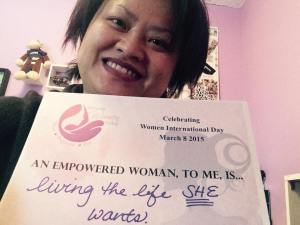 Shortly after this speech, my marriage of 18 years came to an end. He left and I wouldn’t let him back when he had no where else to go. At the family mediation meeting, where I was the only woman allowed to speak, eight men surrounded me, in addition to my soon-to-be ex-husband. For three hours, they told us how we could fix the “minor” problems in our marriage and stay together. They minimized my experiences and perspectives and defended his behavior. Finally, with my brothers by my side, figuratively and literally, I spoke up loud and clear. I reiterated my decision and did not permit them to attack it because they don’t walk in my shoes and they don’t carry my burdens. I have gotten to where I am by on my own merits and drive and I don’t owe anyone anything. So if they expect me to do as they say, they can expect to never see me again as I have no room in my life to be treated with disrespect and disregard. I had nothing to lose and everything to gain. They did not respond directly and ended the mediation.
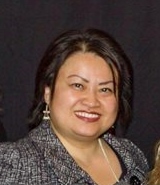 Kabo Yang is an independent consultant and doctoral candidate. She is the principal consultant of Legend Consulting Services, a firm she founded to provide management and leadership consulting to nonprofit organizations. Kabo is an active community member and currently serves on four nonprofit Boards and three committees. She received her Bachelor’s Degree in Business Administration from Metropolitan State University, her Master’s Degree in Organizational Leadership from St. Catherine University and is a doctoral candidate in the PhD in Human and Organizational Systems program at Fielding Graduate University. Her community and research interests are women, migration and integration. Kabo’s dissertation topic will be on the social capital of refugee women. You can connect and follow Kabo on



 MidWest Solidarity Movement