Raising UP Fue Chue’s Hardest Part In Coming OUT to His Family Narrative

FCV

Story #5

Fue Chue Vue is a 22 year old male from Wisconsin. He identifies as Homo-flexible and follows the Hmong Shaman religion.

When I was little, I was always curious. I’d check out guys and girls, however, checking out girls got annoying because my older siblings would always say, “Damn! Check out that girl’s ass! Her boobs are so huge!” So in annoyance, I’ve come to understand my female friends better. I can recall them saying that any girl who is my girlfriend is lucky and why can’t guys be more like me. I thought it was funny that they say that. Throughout puberty and middle school, I noticed I started to check out guys even more. At this stage in my life, I began convincing myself that I was bisexual. I was always afraid to tell my friends. One day after school in my 8th grade year, my friend and I were walking down the hall and she was brave enough to tell me that she, herself, identifies as bisexual. I also told her then I was bisexual. That year in middle school, I had the biggest crush on this guy. I checked him out every time I saw him, I almost felt like a creep because I would pretend not to look at him in class, but would sneak a peek every now and then. (It’s not my fault the teacher assigned these seats!) But I was always afraid of my own sexuality because my family always made fun of those who are gay.

Coming out to my family was the hardest part I had to do. My siblings already knew that I was gay, but we just never really talked about it. However, to my surprise, they were all accepting of me coming out. I’ve always been the odd one in the family so it’s not like I can really hold a conversation with them all the time because they all have mutual interests in sports and cars, whereas I don’t. With my sisters, they all live out of town, but they all are very accepting of me, since I’m the youngest too. My relationship with my siblings changed for the better after coming out. It’s been 4 years since I told my siblings, and life is better. Even though I’m gay, I’m still the same brother that I’ve always been.

I first came out to my general group of friends my sophomore year in High School. I already knew that they knew that I’m gay, but I felt like I had to tell them myself in order to have an even stronger bond with them. They were all fine with it. I was still a little sketchy with my guy friends, because I didn’t know how they’d react to me being gay, being that I’m a male as well. I didn’t want them to be weird around me. So I was only out to my friends and not the whole school. It was a little stressful trying to hide my sexuality.

Coming out to my parents was very hard. I felt like I can never be their son unless I tell them that I am gay. I wanted to tell them that they have a gay son and I’m no different than any other parent’s children. But that one that night when I came out to them, they asked, “Are you doing drugs, because all gay people will end up doing drugs or already on drugs? You are going to jail because gay people are bad and jail is a place for them. No one loves you, not even your siblings, in fact they’ve come to us and told us to tell you to stop being gay. The reason why your mom is feeling sick is because you’re gay, and your presence is hurting her spirits. They’d rather have a son who steals and does drugs than a gay son.” It hurts me because my parents are so caring and respected by our cousins and friends, and they always tell me how sweet and nice my parents are. And to hear these words come out of their mouths really killed me on the inside. Something inside me died that night. That night, I almost committed suicide. I almost jumped off the bridge into the river, but at the last minute, I thought of my baby nieces and nephews. How much I mean to them, even at a young age. Then my friends came to my mind and lastly my family. I cried a lot that night and I really needed to cry it out because I’ve built up so much inside that I needed to let go. So even though my parents and I have our differences, I still love them. It’s been almost a year since I’ve told them. My dad, surprisingly, is more accepting of it than my mom. I recall him saying, “Let him do what he wants. Who cares? People are people.” Although she still tries to convince me to be straight, my mom is a little bit more accepting of it now. I found little steps at a time work.

I feel like the Hmong community is half supportive. A lot of the times Hmong people just ignore that I’m gay, or they just brush it off their shoulders. But many Hmong people are scared, especially the ones that hate Hmong LGBTQQI people. I believe it’s because they’re ignorant (not knowledgeable) and unaware of what I have to go through. Of course everyone knows that I’m gay, but have they ever considered how I feel when they make jokes about gay people? They don’t, and that’s something I am really against. They make it seem as if being gay is disgusting or uncomfortable. I feel that the LGBTQQI community fits on the bottom of our Hmong culture and community. I say this because when I came out to my parents, they basically said that being gay is worse than a son who is a drug addict or someone who steals. However, I always keep in mind that we are slowly making our way up and no matter how many times we are hit down, we will always fight for the rights that we have.

I have not read or found any source about Hmong LGBTQQI people before. I’ve had my own struggles and so I can relate to these people, but I don’t think I can apply them to myself. And I say that because our parents, friends, and peers, are not the same people. Everyone has their own reaction. So reading about it, sure it’ll make me more knowledgeable and understand what they went through, but when I think going through it myself, no matter how hard it is, is the best way to learn.

I think meeting new people, whether they are your friend’s friends or family, or just being in different places is one of the hardest things to face because we don’t know how people will react.

Same goes for telling your uncles, aunts, and grandparent. Because they are from an older generation, it’s harder for them to accept it. Of course they know what gay is and what gay people like, but will they accept it? I don’t think so. A lot of times, people have told me that their elders accept LGBTQQI people, only if it is not their own blood. It’s sad, but it’s the truth. But I’m always going to stay true to myself, no matter how hard things get.

I keep in mind to never give up. I’ve given up so many times before and I’ve been so close to death, but being gay should not be a reason to kill your own self. It sucks being feared and looked down upon, but at least at the end of the day, you know that you are true to yourself. Instead of looking to please others, live your own life. Impressing them does nothing. It just makes them see you as weak and vulnerable. So with my final words, I wish you all the best in life and remember you are not alone, we will help each other.

Please share your story by clicking on the link below:

http://tinyurl.com/HmongLGBTQQIStories

©Linda Her and MidWest Solidarity Movement, 2011 – 2013. All rights reserved. Unauthorized distribution with the intent to sell, use and/or duplication of these images, audio, video, stories, blog posts, and materials on this blog without express and written permission from this blog’s authors and/or owner is strictly prohibited.

Excerpts and links as stated by MidWest Solidarity Movement members may be used, provided that full and clear credit is given to Linda Her and MidWest Solidarity Movement with appropriate and specific direction to the original content.

Raising UP Tou Fong Lee’s Self-Love & Acceptance Narrative

601703_140443082808851_262906657_n

Story #4

Tou Fong Lee is a gay 19 year-old Hmong American man living in Milwaukee, Wisconsin.

The very first time I noticed a same sex attraction was probably back in 5th grade. I saw a pretty cute looking fifth grader who was also a boy.  Of course I did not know what these feelings were at that time, but I did not feel shameful or guilty about having them. Back in 5th grade, life was basically about recess and getting to the lunch line first. It was not until my middle school years that I really started to think about these feelings and emotions that I had towards people of the same sex.

I first officially came out in his Sophomore year of High School.  I decided to take this course of action because I was tired of pretending to be someone else, and I just wanted to be myself!  I was tired of describing a person that I liked with the pronouns She/Her/Hers and wanted to reflect those with the correct terms of He/Him/His, because they were correct with what I was attracted to.  I was only out at school from my Sophomore to Senior Year of High School and on my day of Graduation, I came out to my family and more specifically to my parents.  My mother and I were very close, and I remember sitting down at the table getting ready to come out to her and feeling so scared out of my mind and unsure of her reactions that I bawled my eyes out.  The following two months after I had came out of the closet to my parents, it was very awkward.  Nothing felt comfortable, nothing felt right, and nothing felt close like how it did before.  I felt so isolated and felt like I was a big disappointment because I felt as if I had let my parents down.  I do not think that they have or will ever accept me as myself, but our relationship is slowly getting back to normal, in a sense.  I think it is important to carry out life normally after leaving the closet.  I am still the same person that I was before coming out to everyone. All I can do is continue to be that normal boy.  That’s all I can ask for myself.

One thing that I learned that was important from my personal experience is that before coming out, one has to be ready. By that I mean ready to love yourself, accept, and be proud of who you are.  In my opinion, the whole coming out process is almost a spiritual and life changing step but only if you are truly ready. Coming into terms that you are LGBTQ identified means loving yourself for who you are, and no longer hiding anymore.

For the most part, I am out to everyone. There are still groups of people who I feel do not need to know my sexual orientation or that I have the need to disclose it to them. I feel that at this stage in my life, having experienced many forms of “coming out”, I have no obligation to come out to anyone else now besides the people that I love and who love me in return.  Back in high school when I first came out, I felt the need to tell everyone that I was gay and that I needed all of their acceptance. At a point in my life I started to realize that I did not need to come out to everyone and that it was still okay. I am not, in any way, hiding my sexual orientation or who I am, but more so choosing who to share and open myself up to.  Lastly I think it is obvious that I am an openly gay Hmong American man.

I personally have not heard and do not know of any stories about our Hmong LGBTQ. However, I work as the Executive Assistant at the LGBT Resource Center at the University of Wisconsin-Milwaukee and have started our campus’ first Queer People of Color organization.  I am hoping to bring a sector of Shades of Yellow to our campus.

From my own impression, the Hmong Community is supportive of the LGBTQ community, at least to a certain extent. I feel that the younger generation are more accepting than their parents, grandparents, and the elder folks. I still feel very discriminated against at social events and gatherings. Oftentimes, I just want to belong and talk to someone who I can relate to. LGBTQ Hmong people have always existed in our history.  The only difference was that no one has ever had the chance or support to stand up and make their voice heard until we arrived in the United States of America. I respect the elders in our culture who continues to hang onto traditional roles and expectations.  However, time changes everything, and we too should move forward or we will fall behind. LGBTQ Hmong people are no different than heterosexual Hmong allies.

Some issues that I face today come more from the Hmong culture than the cultures that I seek elsewhere. I identify as a gay Hmong man who face these issues and these struggles within my own culture and race. I feel that our culture is not comfortable and educated on LGBTQ people. When we are faced with change, we struggle to move forward to a mutual understanding. Our entire culture, traditional gender roles, sacred roles such as marriage and funeral ceremonies, do not include or pertain to LGBTQ people. With my own impressions, two husbands or two wives have “no place” in the traditional marriage or funeral ceremonies. That is what makes it hard for LGBTQ Hmong folks who still want to hold onto their roots. Our traditional rules and laws are being “challenged” and forced to face a change that I feel is needed and should be implemented.

Please share your story by clicking on the link below:

http://tinyurl.com/HmongLGBTQQIStories

©Linda Her and MidWest Solidarity Movement, 2011 – 2013. All rights reserved. Unauthorized distribution with the intent to sell, use and/or duplication of these images, audio, video, stories, blog posts, and materials on this blog without express and written permission from this blog’s authors and/or owner is strictly prohibited.

Excerpts and links as stated by MidWest Solidarity Movement members may be used, provided that full and clear credit is given to Linda Her and MidWest Solidarity Movement with appropriate and specific direction to the original content.
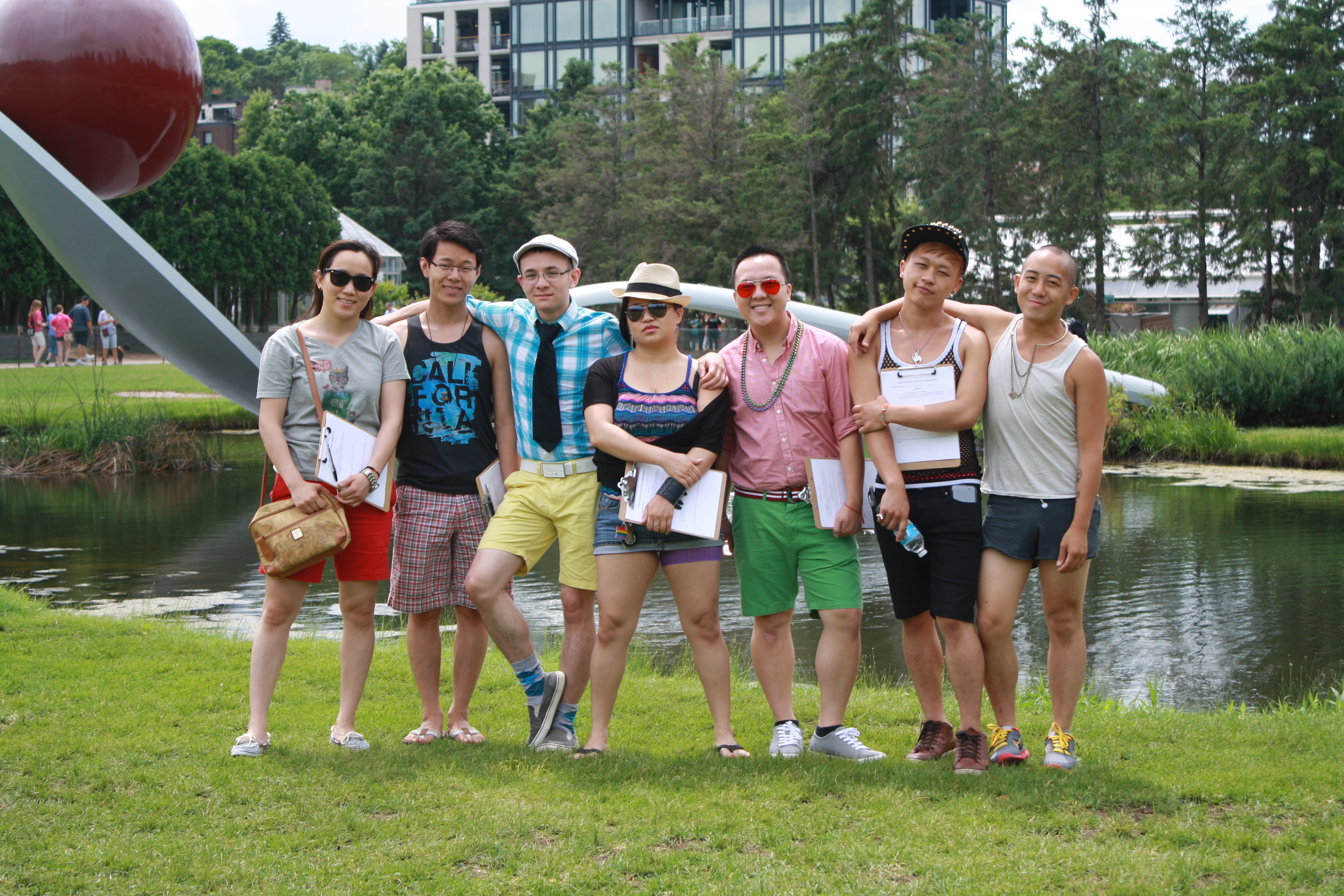
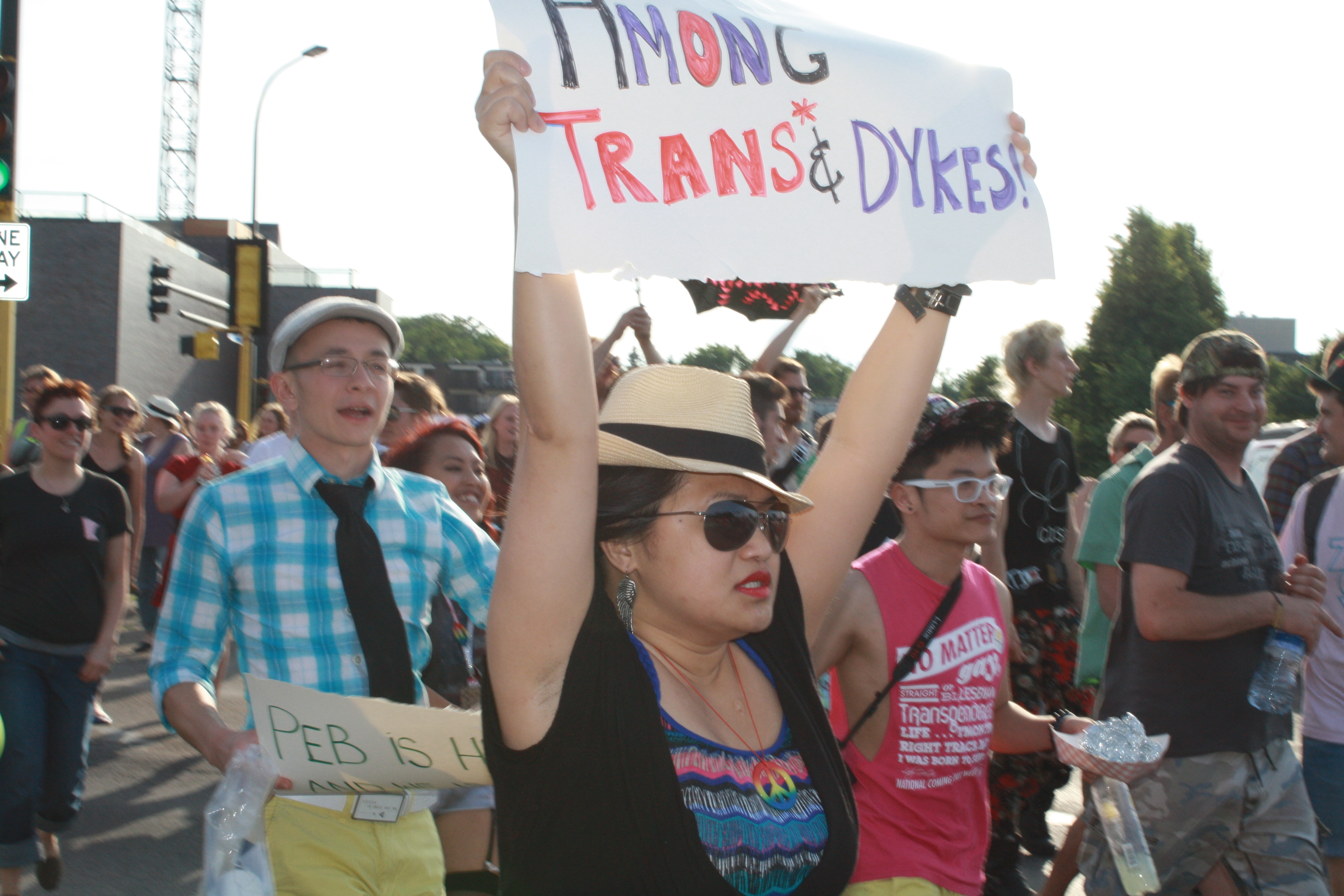
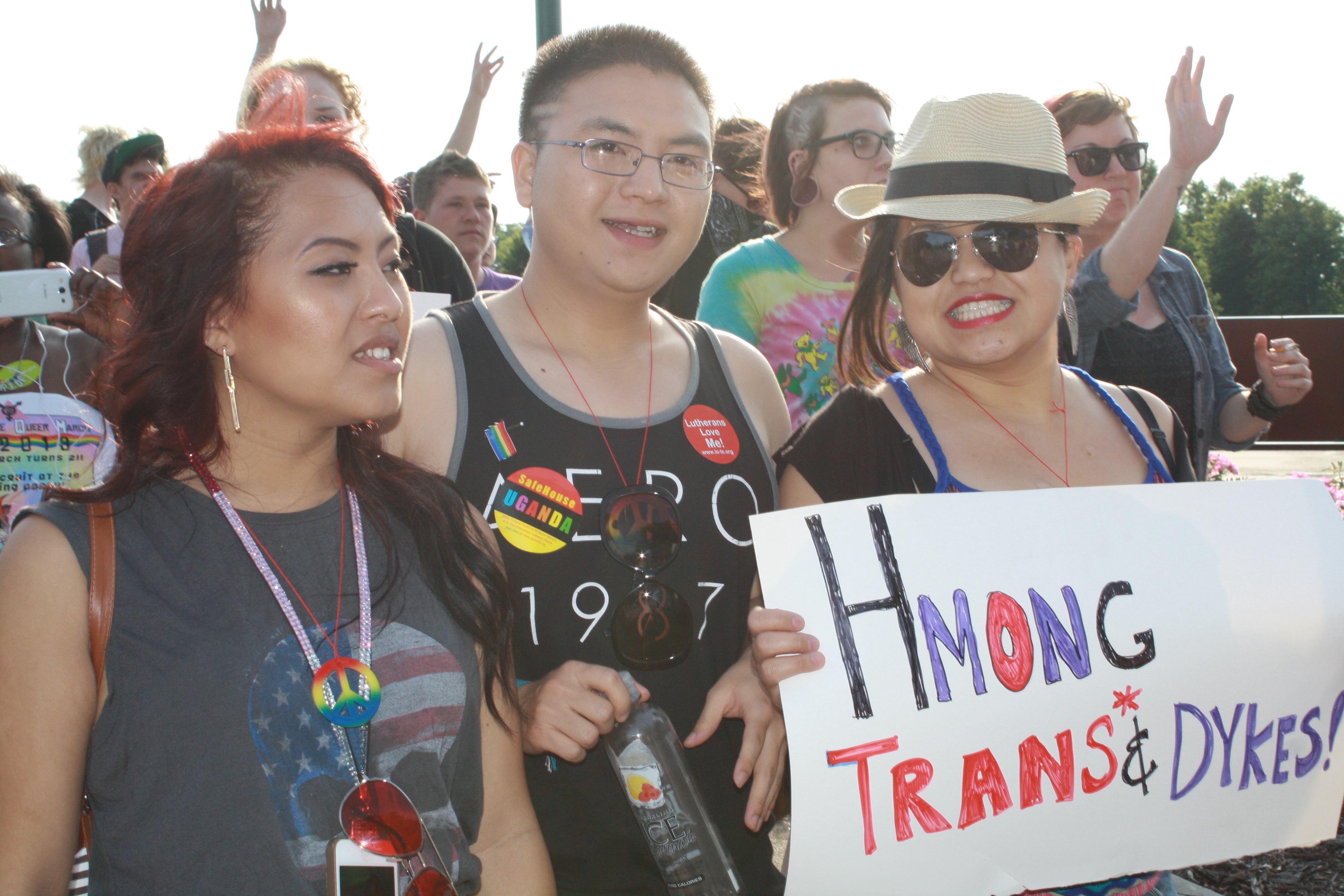
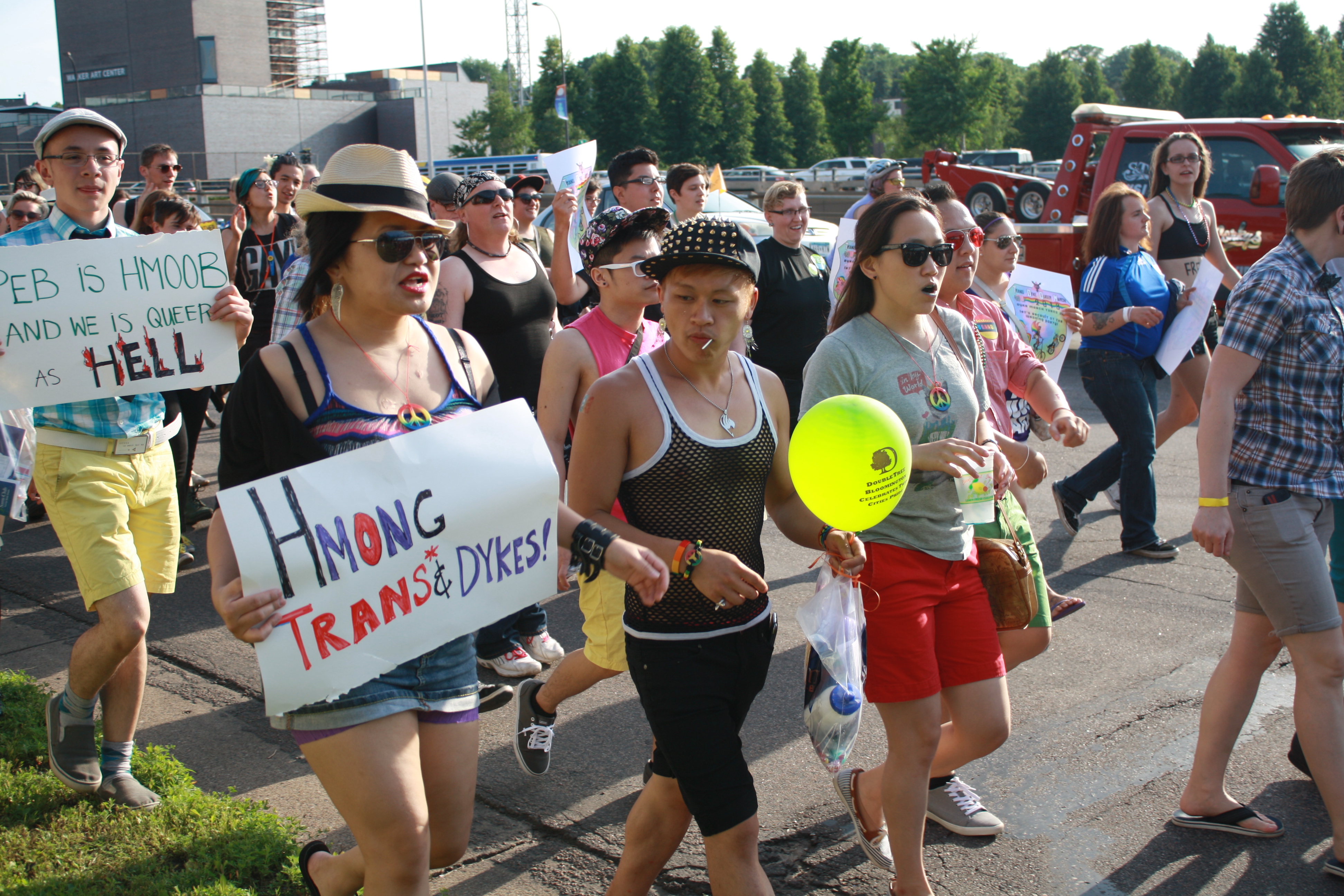
Pride Canvassing & Trans*/Dyke March at Twin Cities Pride, 2013

What an exciting summer this has been! This 2013, MWSM decided to take a different route at Twin Cities Pride (TC Pride). We recruited a team of 10 volunteers to go out and canvass the various non-profits and churches that were present and outreaching about their mission and services. For some of our volunteers, this was their first time at Pride, and canvassing so we made sure to pair them up with someone with canvassing experience. We wanted to find out from the many organizations and churches to identify what services and programs they provided, so we know where to connect our community members to , and possibly collaborate in the near future. The whole team had long and great conversations about the services, leadership dynamics, goal measurements, how does intersectional justice look like in their work, and how do they address institutional racism, white privilege and supremacy. We talked to about 15 organizations and churches, and will be talking to more in the next month to then produce a data report Fall 2014. We will keep you updated!

Meet the team that canvassed!

#MG_4100

#MG_4114

After a morning’s hard work of canvassing at TC Pride, MWSM joined and marched in solidarity with the Trans*/Dyke March.

#MG_4121

#MG_4124

#MG_4126

#MG_4128

#MG_4129

#MG_4130

#MG_4131

HAPPY PRIDE!

Raising UP the Hmong American Bisexual Narrative

A Miao woman in China.
Photo by: Pius Lee http://www.dailytravelphotos.com/archive/2009/03/24/index.php

Story #3

Emo Miao Girl is a 19 year-old bisexual Hmong American woman from California.

In the year 2009, I was a sophomore in high school and I had a friend who claimed that she was “bisexual.” At that time, she was my friend. Of course I shared with her my problems and my curiosity of liking girls. So knowing she was bisexual, I looked up to her for advice here and there just like anybody would. At the end of the year, she moved and we became very distant, however, I eventually found out she was fake the whole time! I also learned that she claimed herself as bisexual simply for others’ attention! Anyway, my bicuriosity kept thriving into the rest of high school.

That was when I had my first and last girlfriend. I was not sure of what I was doing or wanted. I was confused at that time about my sexuality. So I gave it a try and from there I liked the feeling of being nourished by a woman. I knew that it is a woman whom I would share the most common interests with, not to mention the same sensuality with our bodies too. My attitude at that time was that only another woman could understand and love me the way I wanted to be loved. It was a great feeling that I felt, just like how any other couple would have felt.

Coming out as bisexual was difficult because of the fact that I am Hmong. I did not want to make my parents look bad and ruin their “reputation.” I was also afraid that my friends would not like me anymore if they knew about my sexuality. However, after a few months of feeling this way, I no longer cared. I showed off my pride with different colors and began hanging out with a different group of people. I began telling friends about my sexuality even if they did not ask me about it. I wanted to just shut them up so that they would not be so curious anymore.

A scene from the film Miao Miao. Photo credit from: http://www.withanaccent.com/2013/05/08/netflix-instant-files-miao-miao/

A scene from the film Miao Miao.
Photo credit from: http://www.withanaccent.com/2013/05/08/netflix-instant-files-miao-miao/

Facing my parents was the hardest experience for me. I was worried about how my own Hmong people would view me. I could already imagine what my parents will say or do to me if they knew. There seems to be so many things that they dislike in our generation. It seems as if they were born to hate things. They are upset when a daughter dyes her hair, cuts it, goes out, stays up late, or have a friend or boyfriend over. This seemed all too typical of Hmong parents. I am not saying all parents are like this, but I know so many Hmong parent who are like this. I knew the answer all along if I were to come out to my parents. The Hmong community is just too strict, conservative, traditional, and uptight about family reputations. I do not think I will live to see the day where people like us will be accepted by all of society, including the elders in Hmong society. Aside from my parents, even some of my own friends began to keep their distance from me because they thought I was going to hit on them. How sad is that? Soon, I noticed that many people were keeping their distance from me even though I was just a stranger to them.

I have not heard about any Hmong queers growing up. However, my curiosity began to peak and I began to Google about Hmong queers and Hmong LGBTQ to see if there was anything out there. Sadly, the first story that I stumbled upon was about the couple that had committed suicide many years ago. It makes me extremely sad when I read tragic stories like this.

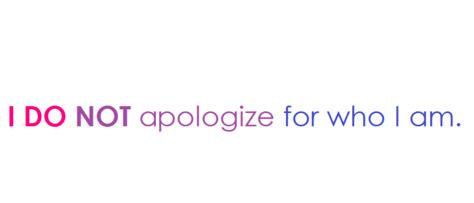
No Apologies Quote credit by: https://www.facebook.com/AwesomeBiQuotes

No Apologies
Quote credit by: https://www.facebook.com/AwesomeBiQuotes

Now, I am out to everyone. I do not care what people think or say about me anymore. It is my life and I want to be myself. I myself am open and supportive of everyone. I do not judge others. We all have a reason why we are the way we are. We are all human beings. We all struggle in life and share problems within society. I would not want to see someone I care for suffer alone.

The main reasons why I came out as bisexual was because I came to a point in my life where I did not care anymore (about what people thought about my sexuality). It has been 4 years since I first was aware of my sexuality. In my experience, most men are asses! Yet, I dated the wrong girls as well! One mistake of my life was dating a girl who was a player. Right now, I am happily in a relationship with a man, my high school sweetie. He understands the struggles that I face. He is a supporter of the LGBT community. Even as an LGBTQ person, dating has been difficult. I just want everyone to be careful with who you fall in love with. However, stay true to who you are. Everyone will dislike you if they know you are fake, and that might include yourself, who is being fake to your own self.

Please share your story by clicking on the link below:

http://tinyurl.com/HmongLGBTQQIStories

©Linda Her and MidWest Solidarity Movement, 2011 – 2013. All rights reserved. Unauthorized distribution with the intent to sell, use and/or duplication of these images, audio, video, stories, blog posts, and materials on this blog without express and written permission from this blog’s authors and/or owner is strictly prohibited.

Excerpts and links as stated by MidWest Solidarity Movement members may be used, provided that full and clear credit is given to Linda Her and MidWest Solidarity Movement with appropriate and specific direction to the original content.